
The future of work in the creative sector – Part 2: From detection to action


Text: Katerina Kalimera
Translation: Tilde Svensson
Images from NextAtlas, ekip.
Knowing a role is emerging raises immediate practical questions: What does that role actually entail? Who can realistically pivot toward it? What skills need to be acquired, and in what sequence? What barriers, financial, educational, infrastructural, stand in the way? And what can policymakers, educators, and industry leaders do to smooth these transitions?
These aren’t abstract questions. For the thousands of European creative professionals navigating rapid technological change, these questions are urgent and personal: Where do I fit in this shifting landscape? How do I get from where I am to where opportunities are emerging?
The backcasting methodology provides answers through mapping the actual career transitions already visible in practitioner communities.
Case study: The interactive storyteller
The journey from today’s roles to Interactive storyteller illustrates this approach. Through social listening, Next atlas identified this emerging profession at the intersection of narrative design, user experience, and immersive technology. But rather than simply describing the role, the backcasting process revealed multiple practical pathways.

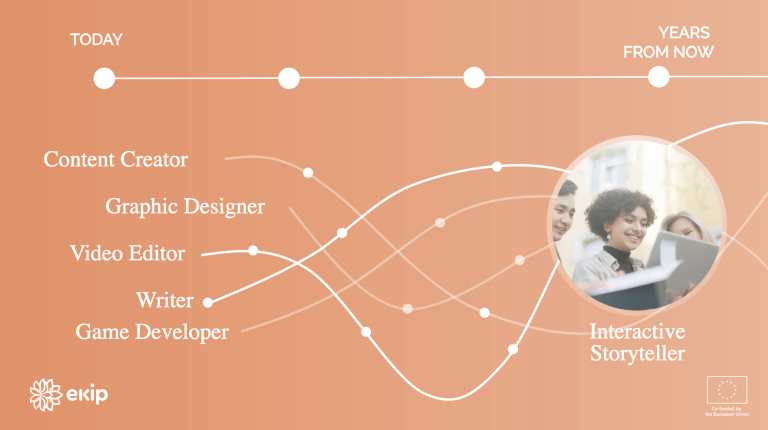
One trajectory begins with a Graphic Designer: a widely established role focused on visual communication and aesthetics.
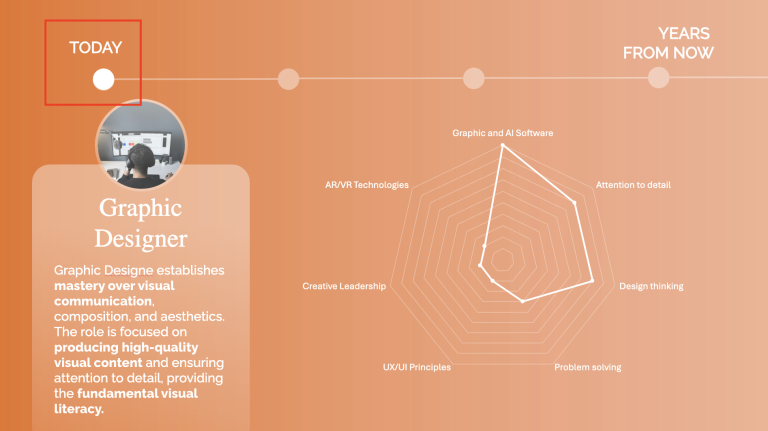
The first strategic pivot leads to UX Designer, where the focus shifts from pure aesthetics to functional design addressing user behavior and digital flow. This requires acquiring UX/UI principles and design thinking methodologies.
.png)
The next evolution leads to Experience Designer, where the scope expands beyond 2D screens into immersive and spatial design. This stage demands proficiency with AR/VR technologies and developing system design for complex, non-linear experiences, skills that build naturally on the UX foundation.
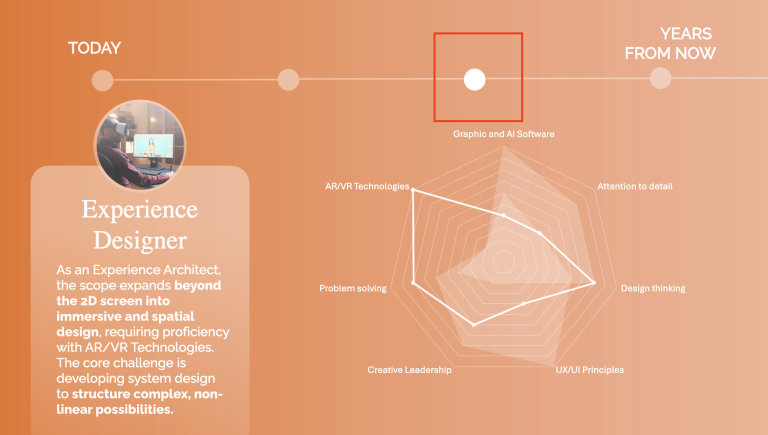
Finally, this trajectory culminates in the Interactive Storyteller role, combining visual expertise, user-centered design, spatial thinking, and narrative craft. Each step represents an achievable skill expansion rather than a wholesale career change.

Crucially, the research identified that this same destination role can be searched from multiple starting points. A game developer might approach Interactive Storytelling through narrative mechanics and player agency. A video editor could pivot through motion design and temporal storytelling structures. This multiplicity of pathways is vital for policy. It means interventions can support diverse professional backgrounds while working toward the same emerging roles.
But how does the methodology distinguish between temporary hype and genuine structural transformation? The answer lies in analyzing patterns of emergence over time.
Short-lived trends show steep, sudden surges in conversation, usually triggered by a viral moment or product launch. These “volatile entities” grow fast but decline just as quickly. In contrast, deeper structural shifts emerge through slow, cumulative build-up across multiple communities and contexts, showing steady growth, cross-domain relevance, and increasing semantic complexity.
The Next Atlas team points to AI in creative work as a prime example. While the mainstream conversation exploded in 2022–2023 with the rise of Midjourney, Stable Diffusion, and ChatGPT, their models were already detecting early signals as far back as 2019, artists, designers, and musicians experimenting with generative processes, computational aesthetics, and hybrid human-machine workflows. These early mentions were scattered but consistent, emerging across different creative sectors. Over time, they layered on top of one another and formed a cultural trajectory.
When the mainstream “boom” arrived, it wasn’t a surprise but the visible tipping point of a shift that had been maturing for years. This advance warning should really allow policymakers and educators to prepare rather than react.
Beyond job titles: Identifying systemic needs
The backcasting analysis reveals systemic patterns in what’s needed to facilitate these transitions. Across multiple merging roles, several critical themes emerge:
Access to cutting-edge tools and training: Professionals across all mapped pathways require accessible training in expensive, cutting-edge tools like AR/VR and advanced AI software. The social listening data reveals frustration in creative communities about the gap between what practitioners need to learn and what training is available or affordable.

“There’s a consistent need for support to integrate technical fundamentals like NLP/ML basics into traditional humanities and creative training,” Next Atlas team observes. This isn’t about turning creatives into programmers but providing enough technical literacy to collaborate effectively and understand possibilities.
Networking and cross-sector collaboration: The new roles demand intense collaboration between diverse expertise: creative leaders, problem solvers, technologists, and even legal teams. Yet professional networks often remain siloed by discipline. The research suggests major value in incentivising and funding cross-sector collaboration platforms. Innovation portfolio approaches that create systematic opportunities for diverse actors to work together, rather than relying on ad-hoc project funding, are particularly promising for supporting the experimental work that defines emerging professions.
Funding and investment models: To support the R&D and pilot projects needed for professionals to gain experience in capital-expensive fields like immersive storytelling or AI ethics, there’s a critical need for long-term financial products and grant structures. Short-term project funding doesn’t allow for the experimentation emerging roles require. Research into sustainable innovation funding models suggests that public funding mechanisms need fundamental restructuring to support the iterative, risk-tolerant work that defines early-stage professional development.
From insight to action
The value of this methodology lies in preparation. By identifying emerging roles while they’re still nascent, policymakers gain critical time to develop responsive interventions.
Educational institutions can begin integrating key skill areas before demand peaks. Professional development programs can design targeted upskilling around identified pivot points. Funding bodies can structure grants to support the experimental work that defines new professions.
For practitioners, these career maps provide something equally valuable: agency. Rather than feeling buffeted by change, professionals can see concrete pathways forward, understanding which skills to priorities for their desired trajectory.
“The backcasting process proves that the path to future CCI professions is not a leap, but a guided series of skill pivots and strategic upskilling,” emphasize Debora Bae and Greta Cappellin. “The next step is to use this map to actively guide and reorient current professionals toward these emerging opportunities.”
Looking forward
ekip project foresight exercise represents an ongoing effort. As the CCIs continue evolving, new professional roles will emerge, and existing trajectories will shift. The social listening methodology provides a dynamic monitoring system, capable of detecting these changes as they unfold in practitioner communities.
Future phases will expand coverage to additional emerging roles, validate career pathways through practitioner feedback, and develop specific policy recommendations for supporting workforce transitions. The ultimate goal is transforming early signals into actionable frameworks that help both individuals and institutions navigate change effectively.
In an era of rapid technological and social transformation, the ability to anticipate professional evolution becomes a competitive advantage, for individuals, organisations and regions. We need to listen carefully to the conversations already happening in creative communities, so as to be able to move from reactive adaptation to proactive preparation, ensuring that European cultural and creative industries have the skilled workforce they need for tomorrow.
The future of work in the CCIs is being discussed right now, across countries’ social media conversations. We need to keep using the right tools and methodologies, in order to tune into those discussions and translate emerging signals into the building blocks of smarter policy, more responsive education and more empowered creative professionals.
The Interactive Storyteller illustrates the backcasting approach, but it’s not the only emerging role reshaping Europe’s creative landscape. AI Ethicists are emerging from journalism and humanities backgrounds, while Heritage Strategists are bridging cultural education with digital innovation and community engagement. Want to explore these pathways in depth? Stay tuned for future ekip articles, or contact us through our channels to discuss how these insights can inform policy in your region.
A note on language: Throughout this article, we use terms like “emerging roles” and “future personas” not to suggest these jobs don’t exist yet, but to acknowledge they exist in practice before they exist in policy, curriculum, or official labor statistics. When we say “Interactive Storyteller,” we’re naming work that hundreds of Europeans already do, but under fragmented titles without clear career pathways.
This article is part of the ekip project’s ongoing research into workforce development in the Cultural and Creative Industries. For more information about emerging roles and career pathways, visit the ekip platform or explore the full backcasting personas report.