
INTERWeuVen: Reducing textile waste through 3D-knitted garments
A new European project is now launching to combine textile infrastructure and weaving machinery in an innovative way. The concept is to create textiles directly in the shape of the final product, with the goal of reducing overproduction and waste within the European textile industry. INTERWeuVEN is an EU Horizon project coordinated by Delft University of Technology (TU Delft), involving 16 partners across 8 countries. The project will run from September 2026 to August 2030 with a total budget of 5 million euros. Future by Lund and its member whatt.io are participating in the project, where they will, among other things, assist in integrating DPPs (Digital Product Passports) into design and manufacturing processes, as well as establishing a Nordic circular textile network.
Finanisär
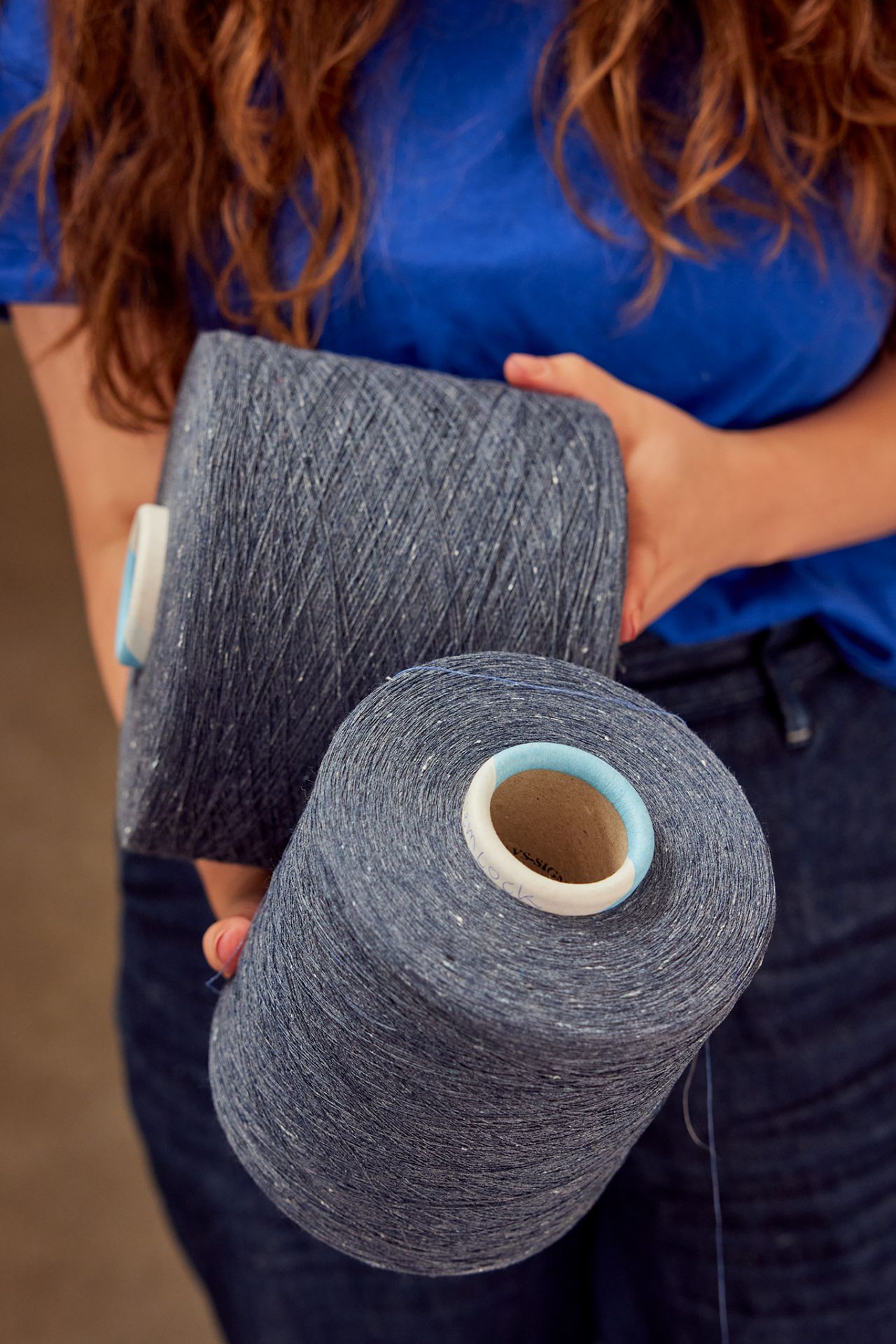
Photo: Anouk Moerman for Secrid
The textile and clothing industry's most intractable problems are not a lack of sustainable materials or good intentions, but rather structural overproduction and material waste. The project INTERWeuVEN hopes to address this by developing Textile-Form Weaving (TFW): a method that simultaneously creates a woven textile structure in a product shape, eliminating cutting and sewing and enabling zero-waste clothing production at a micro-factory scale. The process is designed to be profitable even within high-wage European economies.
The project works across many different application areas. It is developing AI-assisted design tools and digital interfaces that make TFW accessible to industry designers, while investigating the systems that determine whether new manufacturing models can take hold - business models, digital product passports, life cycle assessments, and policy frameworks. Everything is being tested through Exploratory Labs and industry pilots at test sites in the UK, the Netherlands, Spain, and Sweden. The goal is not just prototypes and examples, but a model: a local, automated design-to-manufacturing service that is locally rooted, digitally integrated, and built for the realities of European textile production.
“The textile industry's overproduction problem isn't going to be solved by better intentions. INTERWeuVEN starts from the making – from what becomes possible when you design textile structure and product form together, on demand, at the scale of a local microfactory. That's where the system actually changes", says Holly McQuillan, INTERWeuVEN project lead and Assistant Professor of Multimorphic Textile Systems at TU Delft.
The project is set against the backdrop of the textile and clothing industry being one of the world's most resource-intensive and environmentally damaging sectors, contributing up to 10% of global greenhouse gas emissions while driving resource extraction, labor exploitation, and excessive waste.
In Europe, a 20–40% overproduction of clothing leads to vast amounts of unsold inventory, wasted resources, and unnecessary emissions. The new EU legislation, Ecodesign for Sustainable Products Regulation (ESPR), will ban the destruction of unsold clothing, accessories, and footwear for large companies starting July 19, 2026. Medium-sized companies will be covered from 2030. The INTERWeuVEN project is working on the premise that the solution lies in tailored design and manufacturing systems that produce garments on demand in an efficient, sustainable way, in line with circular economy principles.
"Regulations, technology, and the market are all putting pressure on the industry right now. That is why INTERWeuVEN is so important. The project tackles one of the industry's toughest problems - overproduction and waste -and makes the transition concrete and testable for both academia and industry. For us at Future by Lund, this takes shape through our DPP test wall: a physical and digital meeting place where fashion and textile players test digital product passports in practice. It is where we build the expertise and connections that will carry our playground for industry transformation forward, long after the project ends in 2030," says Lars Mattiasson, project manager for the Fashion & Textile Transformation portfolio at Future by Lund.
In INTERWeuVEN, Future by Lund will work with whatt.io to develop a roadmap for the implementation of DPP (Digital Product Passport) in manufacturing. It will also involve assembling a Nordic circular textile network of cities, SMEs, and brands. Future by Lund and whatt.io will host matchmaking and demo days, support municipal procurement pilots for DPP-enabled products, and facilitate cross-border projects that scale the roadmap across Sweden and the Nordic region. All of this work will also provide insights back to the project and to future policies and standards.
"For us at whatt.io, a Digital Product Passport is not about adding a digital label to a finished product. The truly interesting part happens when the DPP is built in from the moment of design and manufacturing. In INTERWeuVEN, we can let the digital product identity be born at the same time as the garment itself - with information about materials, manufacturing, usage, and future circularity that follows the product throughout its entire life cycle. This is exactly the type of practical DPP implementation we need to move from regulations to functional industrial solutions," says Stefan Larsson, CEO of whatt.io.
whatt.io is also participating in the EU project CIRPASS-2, where stakeholders are demonstrating functional digital product passports in real-world environments.
Footnote: INTERWeuVEN has received funding from the European Union under grant agreement No. 101294237. However, the views and opinions expressed are those of the author(s) only and do not necessarily reflect those of the European Union or HaDEA. Neither the European Union nor the granting authority can be held responsible for them.
INTERWEUVEN: On-demand, zero-waste textile micro-factories for resilient fashion futures
Project funding: 5 million euros.
Participants: Technische Universiteit Delft (coordinator), Canon Production Printing, Technical University of Dresden, The University of Manchester, Manchester Metropolitan University, Future by Lund, whatt.io WIO, Inria, Erasmus University Rotterdam, AITEX, CLO Virtual Fashion, Lululemon, QMatex, Circular Rotterdam, Enschede Textielstad Innovatie.
Associated partner: NedGraphics
Project duration: September 2026 to August 2030
Project coordinator: Holly McQuillan, TU Delft
Project Manager Future by Lund: Lars Mattiasson


