
Creativity is the great advantage of Europe
* (We use KKN here but see it as broadly synonymous with Cultural and Creative Sectors, FGM, and Cultural and Creative Industries, KKB).
Cultural and Creative Industries (KKN) activities contribute more to Europe's GDP than many realise — in fact, more than car production in some countries and more than agriculture in others. But the real potential for KKN lies in spillover effects, such as gaming technologies bolstering virtual training for pilots, fashion driving material innovation or architecture shaping climate adaptation.
“In saturated global markets, it’s no longer the classical good that makes the difference — it’s the story behind it,” says Harald Hartung.
Side effects of KKN
Apple is often seen as the brainchild of American technology dominance.
“Apple married culture and art with technology from the start,” “That is why their products sell for triple the price of competitors. Europe may lack a single Apple-scale success story, but it has something else: a vast cultural and creative industries (CCI) that many countries would envy — if only the EU could learn to use it strategically.”
Finland is perhaps the most compelling example.
“Hundreds, if not thousands, of micro gaming companies have emerged. Their expertise spills into virtual and augmented reality, training simulations, and industrial innovation.”
And in the music industry, 50% of American list hits were composed or produced in some years by Swedes, a success that did not come by chance but arose out of decades of investment in local music schools, community programs, and structured talent development across the country. Belgium has done the same with fashion.
The right actors at the right time
Europe faces extreme stresses: climate, defence, geopolitics and demographic change.
“Everybody is calling for money,” says Harald Hartung “But the challenge is not the amount - it’s making it available to the right actors at the right time.”
And the right actors are in culture: artists who translate the climate crisis into lived experience, designers who reinvent sustainability, technologists who understand cultural heritage, architects who design for resilience.
“Art helps us understand complexity,” is Harald Hartungs belief. “It connects disciplines that otherwise stay locked in their silos.”
The Americans learned this early.
“In Silicon Valley, artists and engineers work at the same level. They co-create solutions from the beginning. Europe could learn from this.”
If Europe is serious about global competitiveness, KKNs cannot remain marginalized in politics.
“This is not cultural decoration – it is the core of our economic model.”
Europe allocates significant resources to KKN but in such a fragmented and opaque way that even experts get lost.
“The landscape of funding is so scattered that even I couldn’t get the full overview. If I can’t, how can a small company? The problem isn’t a lack of money. It’s that the money is locked in silos, difficult to gain access to. "
Open up structural funds
At the same time, Europe is negotiating its new research and innovation budget of 175 billion euros for Horizon Europa.
“Now is the moment to influence it,” Harald Hartung stresses “If Sweden, if local governments, if universities don’t speak up now, the next decade of funding will bypass CCIs if not combined financing modalities will be put in place.”
Because, despite its economic weight, KKN is still not considered to be eligible for many national allocations from the EU Structural Funds — especially the smart specialisation strategies that shape regional development.
“My plea is to open structural funds to the CCIs. They are SMEs, they drive spillover, and they generate growth. But it´s up to the member states to decide.”
ekip lays cornerstones
The second problem is Europe's chronic inability to work across sectors.
“We have many dots — good dots — but no framework to connect them. We don’t need new bureaucracies. We need an ecosystem.”
Harald Hartung highlights ekip as an important building block for creating the ecosystem that Europe needs. Although other EU platforms exist, none work directly on policy development with a level of systematic ambition.
“In my view, ekip is laying the cornerstones — developing policy, testing ideas, and making them public.”
ekip can be seen as the first bottom-up ecosystem for cultural innovation: bringing together cities, practitioners, researchers, intermediaries and policy makers in an ecosystem that functions more like a laboratory than a committee room.
“You need an atmosphere favorable to risk-taking and imagination, and ekip creates exactly that. Its work gives policymakers something they often lack: grounded evidence of how creativity can transform cities, industries and social systems — not in theory, but in practice. ekip, if sustained and integrated, could become the vehicle that drives this shift — the bridge between creativity and innovation, between imagination and industry emphasizes Harald Hartung. Supporting the creative economy is not a cost –it is an investment in Europe’s future competitiveness.”
Harald Hartung´s analyse on what the CCI in Europe need:
* A political decision to treat CCIs as a strategic sector, not a ‘nice-to-have’.
* A shared ecosystem linking EU, national and regional actors around innovation.
* Joint programmes between DGs, not simply information exchange.
* Long-term structures, not project-based funding that ends abruptly.
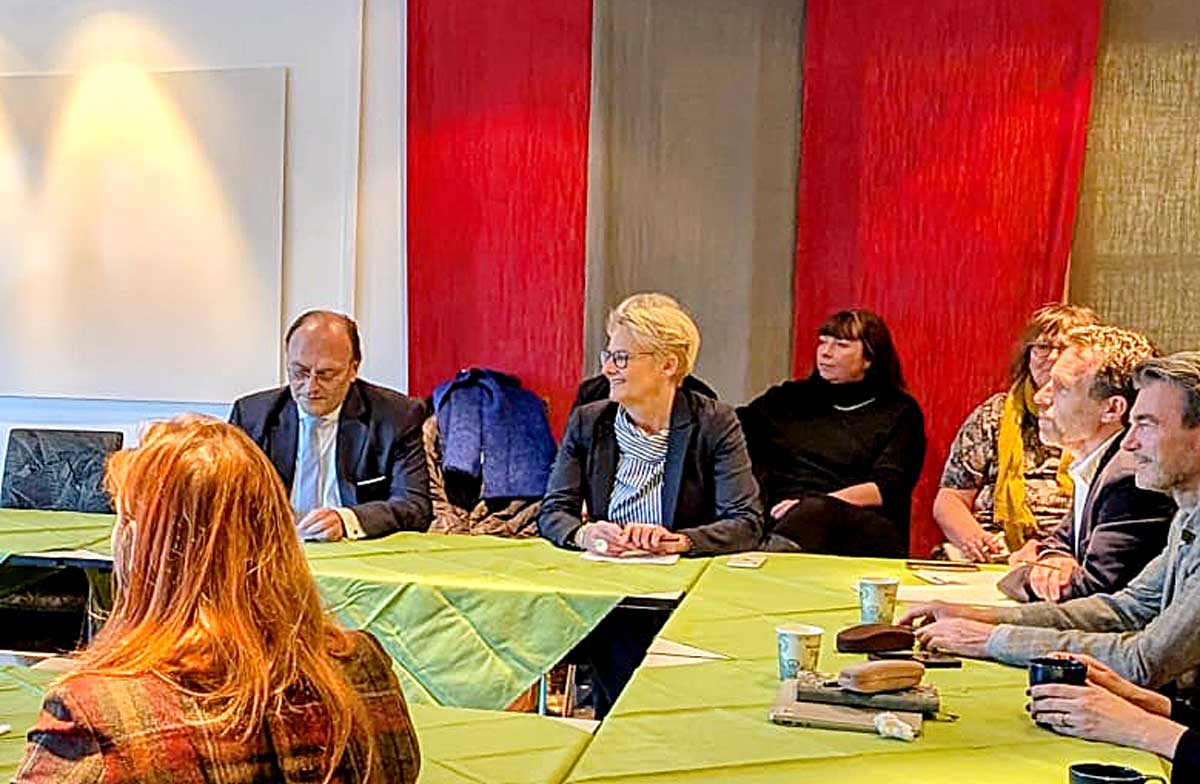
Harald Hartung participated at Round Table on Innovation Polices for the Cultural and Creatives Sectors and Industries, hosted by ekip and Riksteatern.