
Top international students to Lund for studies in food and packaging
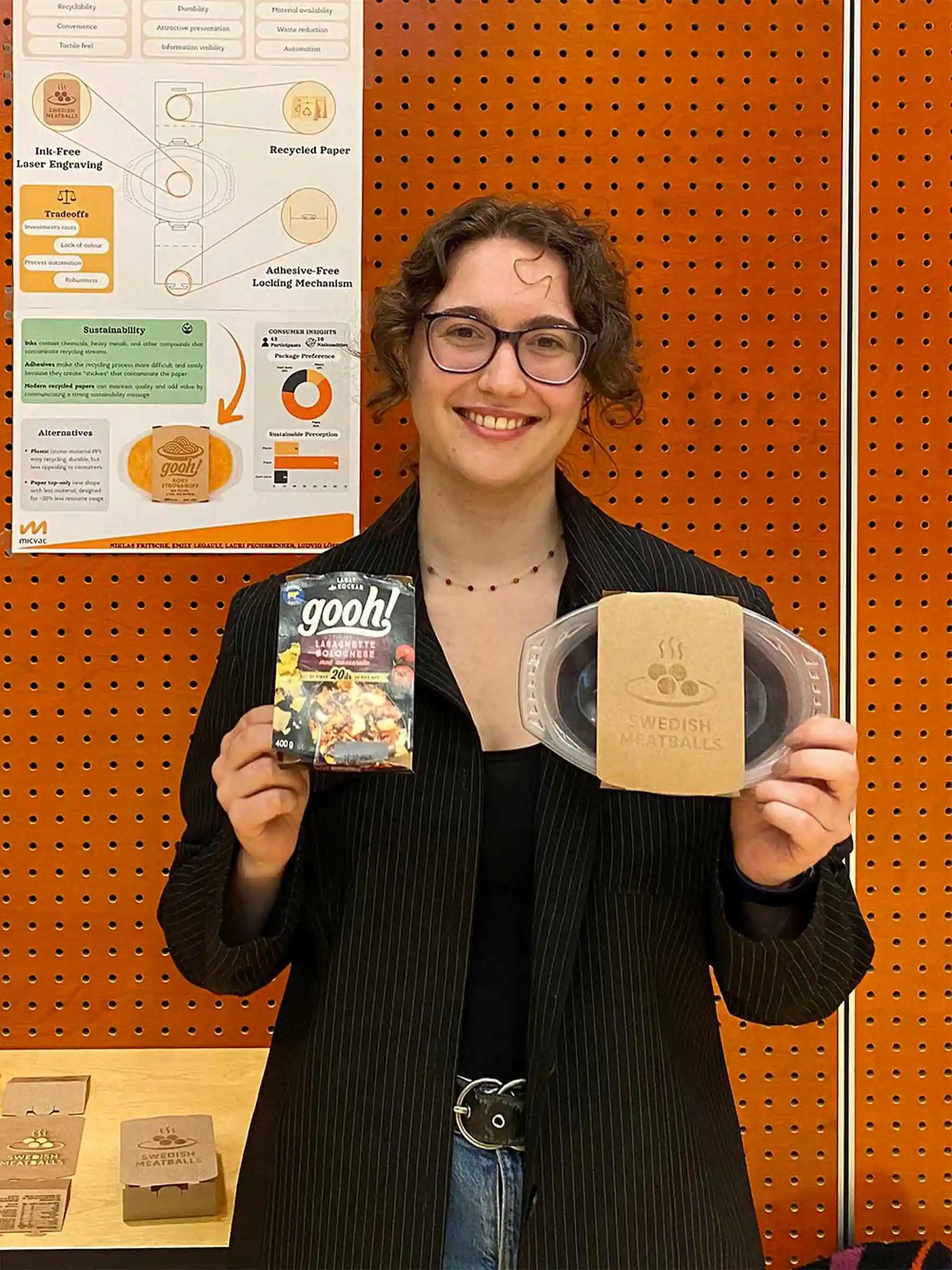
Pictured: Emily Legault presents her packaging solution during the course at LTH. Photo: Erik Andersson at Dept. of Design Science
Universities of Naples, Paris, Dublin and Lund working together to create a collaborative education that covers the entire value chain from food to packaging and logistics. Next year, the program may FIPDEs (Food Innovation Product Design) supplemented by the participation of a university in Ghana for those who want to work with tropical or equatorial diets.
New food, sustainable packaging and good logistics solutions are all important elements for creating climate-smart solutions. Many young people are engaged in solving these types of challenges - it is noticeable, among other things, that the program has a high search pressure. Each year, the program receives up to 1,500 applications from all over the world to the 25 locations.
"To enter, you must have a relevant Bachelor (Bachelor's degree), but the personal letter is also very important, says Lars Palm, senior lecturer at Lund University. The course is attended by highly motivated students from all over the world - a large percentage from Asia and South America but also from, for example, Africa and Europe. Many see it as a great career opportunity but so are a large number who are driven by their passion and love working in food, nutrition or packaging. "
Students start with a semester in Paris where they study basic physics, chemistry and food knowledge but also project management, innovation and creativity. After that follows a six-month stint in Dublin with an emphasis on the culinary and food projects. During the third semester, it will be possible to choose Lund to deepen in packaging and logistics. Two other specialization options are to continue with a food focus in Paris or to study nutrition in Naples. About a third of the participants choose Lund, where they attend courses together with other students with relevant education at LTH. The courses are in innovation and packaging technology followed by courses on packaging materials and logistics.
During the course in packaging technology, industrial actors are invited to present a need in packaging. Students are given eight weeks to work on creating a package and provide the companies with a report, a prototype and a poster.
- We decouple students from certain requirements, such as ancillary conditions and costs, in order to make it possible to catch up, says Lars Palm. The aim is to inspire the company and not to provide a ready-made solution. For students, it is valuable that there is someone who is actively interested in their work.
This year, eleven projects were presented with commissions from Ikea, Jula, Alfa Laval, FrontPac, Tetra Pak, Micvac and Orkla. The work takes place at a high pace in agile teams assembled by Lars Palm.
- I mix participants with different educational backgrounds in the groups because that is what the task requires. It is important that the group participants have different competencies to solve these complex tasks. A cross-functional and multicultural group takes longer to start but produces better results than a homogeneous group.
What does it give to be part of FIPDEs?
- For the university, the education provides visibility and relevance for research and gives us an opportunity to work in an international context. It also provides a meeting with a wider range of skills and networks. For me personally, it is a privilege to be able to hang out with young people with the same interest as I have. The sustainability aspect is important to students, and there is a commitment to change things. Since there is a lot of new legislation coming up in the field of packaging that many are not aware of what it means, I believe that students are also in the winning hole for a good career after this education.
Here you can make an application.
