Routes: Playfulness as a solution to complex challenges
Future by Lund has taken on an observer role in the Horizon project ROUTES. Over the next four years, the project will explore how to transform schoolyards and their surrounding streets into inclusive, vibrant community spaces that promote accessibility, well-being, and social cohesion for everyone. Furthermore, the project will develop methods for measuring these changes, serving as a model for demonstrating the outcomes of complex urban challenges.
Finanisär

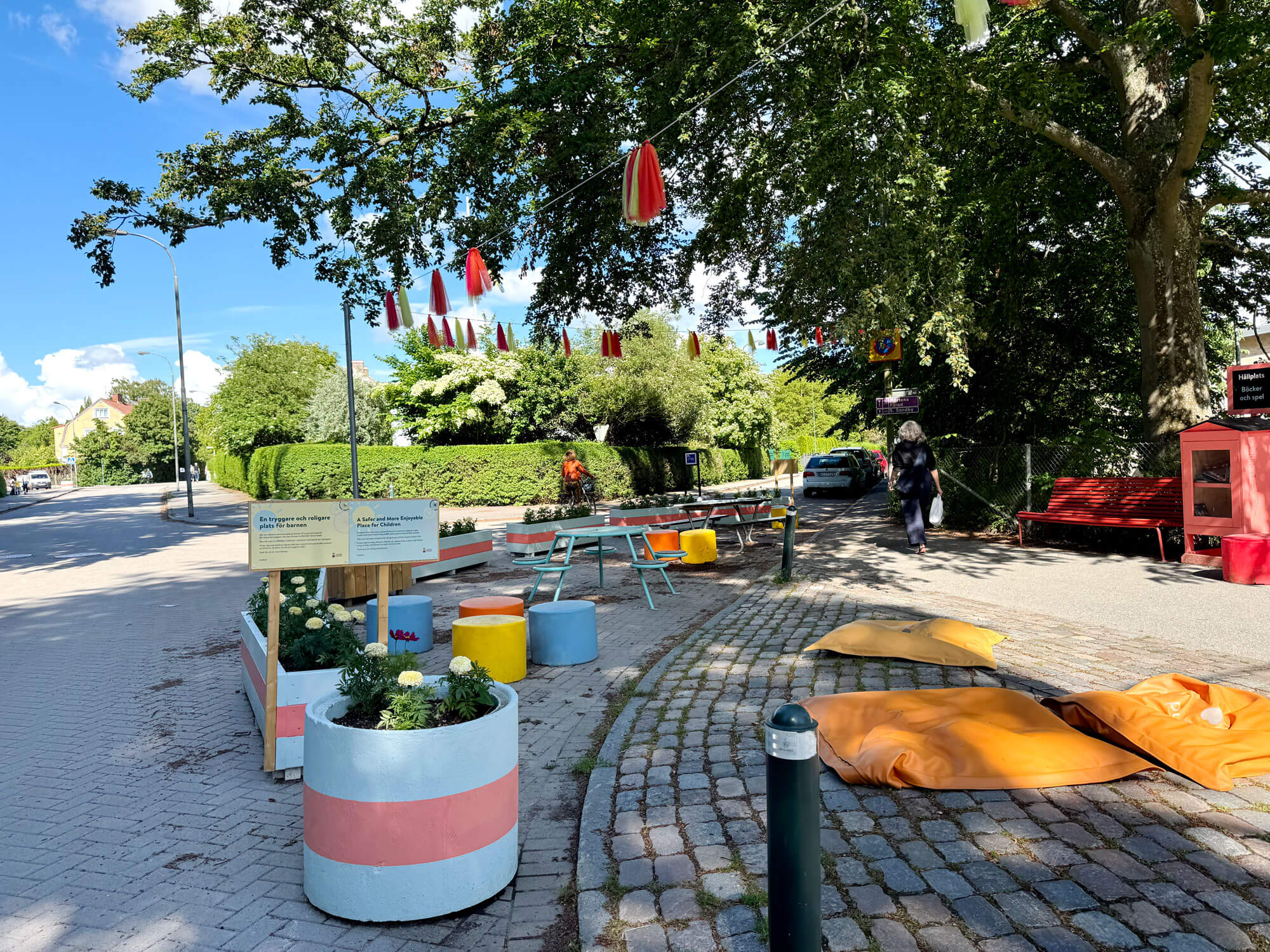
Across Europe, schools serve as accessible neighborhood hubs that can remain active even after the school day ends. Policy frameworks and research findings often treat schoolyards and adjacent streets as separate entities governed by different regulations. ROUTES (Reimagining Open schoolyards and Urban sTreets as Equitable Spaces) views this as a barrier preventing school environments from reaching their full potential as shared spaces. Guided by the New European Bauhaus values of beauty, sustainability, and community, ROUTES is reimagining schools and their surrounding streets as communal neighborhood laboratories that connect education, community, and the environment. The project brings together 15 partners from 8 European countries, including universities, non-profits, SMEs, and municipalities. Over 4 years, the project will engage citizens, students, parents, teachers, and local authorities in living labs across eight pilot sites in Bratislava (Slovakia), Espoo (Finland), Rotterdam (Netherlands), and Tirana (Albania) to co-design tactical integrated interventions and measure their impact on neighborhood safety, inclusion, social cohesion, mobility behavior, and subjective well-being.
ROUTES employs a multidisciplinary and multi-level engagement approach that combines methods from urban analysis, environmental psychology, citizen science, behavior change theory, tactical urbanism, and co-design. The project will co-develop practical tools to measure the medium- and long-term impacts of integrated transformations, as well as evidence-based guidelines to facilitate scaling.
The participating organizations possess expertise in architecture, urban planning, mobility, human geography, environmental psychology, co-creation, design, policy, and governance. By utilizing a work structure that ensures the involvement of research institutions, local authorities, and community organizations, ROUTES aims to demonstrate how integrated transformations of schoolyards and school streets can generate significant social benefits for entire communities. The project will showcase the potential of schoolyards and adjacent streets as unified, inclusive common spaces and then measure their impact on community cohesion and participation. The project is considered to go beyond the current state of the art, presenting a methodological innovation by combining schoolyard and school street transformations to assess broader societal impacts. Furthermore, it integrates tactical urbanism, environmental psychology, and advanced analysis into a multi-layered framework, the ROUTES Atlas, for impact assessment, which is seen as a compelling advancement beyond the current state of the art.
The project includes four pilot cities—Bratislava, Espoo, Rotterdam, and Tirana—and four observers with various areas of expertise, including Future by Lund. Observer cities gain access to the project's tools and methods in the ROUTES Atlas before its release and have the opportunity to learn directly from the pilot cities through exchanges and collaborative activities. It is also an opportunity to connect with a European network of cities, academic institutions, non-profits, and SMEs that are driving integrated transformations between schoolyards and streets.
Future by Lund serves as an observer focused on innovation and how to build joint development efforts, testbeds, and methods, including measuring results to achieve impact regarding complex challenges.
"The consortium brings together cross-cutting knowledge on how to create impact and drive collaboration, which also provides Future by Lund with input for our own portfolio and methodology work," says project developer Katarina Scott. "We will also be able to deepen collaborations with European partners."
ROUTES (Reimagining Open schoolyards and Urban sTreets as Equitable Spaces)
The project is funded by the Horizon New European Bauhaus program, Horizon Europe
Project Lead: Delft University of Technology (TU Delft).
Project Duration: 48 months
Project Participants: Technische Universiteit Delft, Technische Universität München, Ecole Nationale des Travaux Publics de L’Etat, Aalto Korkeakoulusaatio, Universiteti Politeknik i Tiranes, Humankind, Fransen, IVN, Instituut voor Natuureducatie en Duurzaamheid, Stichting Bycs Global Foundation, Fondazione transform transport ETS, Agjencia Kombëtare e Planifikimit të Territorit, Metropolitny Institut Bratislavy, Gemeente Rotterdam, Espoon Kaupunki, Rear Window, Qendra Marredhenie