
Open innovation is one of our pillars
Based on an article by Lena Holmberg, Lund University.
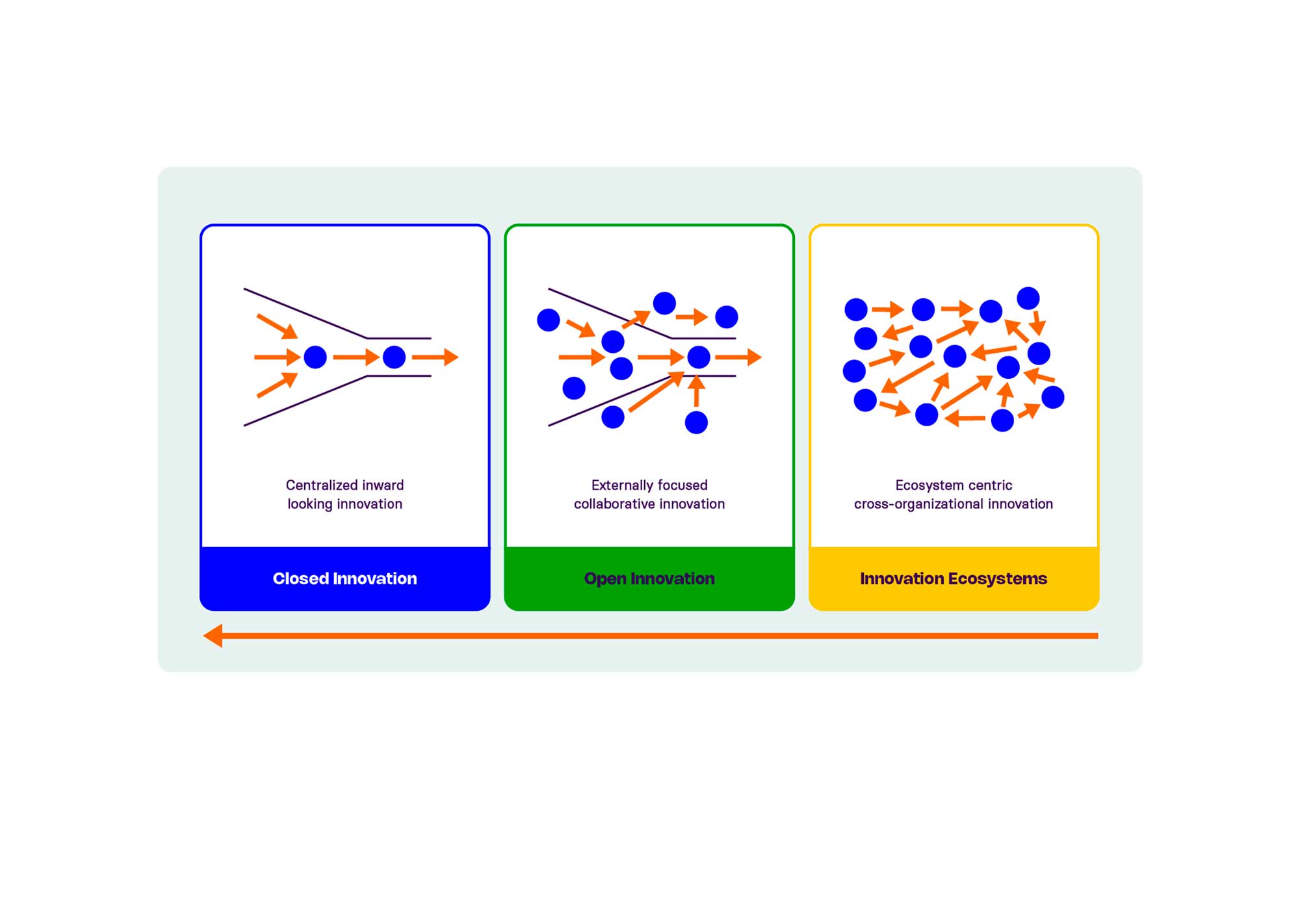
Through Open Innovation, companies can use external ideas, knowledge and technologies together with their own R&D to develop products and services. In the process, partners, customers or researchers work together to streamline development. At the same time, you can also share ideas that do not fit in your own business.
Popularized by Henry Chesbrough in 2003, Open Innovation describes how organizations accelerate development by combining internal ideas with external collaboration with actors such as startups, universities, and clients. Ten years later, Martin Curley, together with Bror Salminen, expanded the concept of Open Innovation 2.0, emphasizing a mindset of adaptability and teamwork to drive impactful innovation.
Researcher Marcin Poprawski at Humak University of Applied Sciences emphasizes in an article by Lena Holmberg on Lund University that Open Innovation does not mean giving away knowledge gathered during the innovation process to anyone, anywhere, at any time.
- Open Innovation should be seen as a strategic and coordinated process, an agreement between the parties involved to consciously explore innovative solutions together. This means that Open Innovation is rooted in mutual trust, respect and transparency about stakeholders' intentions,” explains Marcin Poprawski.
The collaboration in Future by Lund takes place through Open Innovation in innovation portfolios that create opportunities to develop complex areas.
Portfolios are about the movement or transformation of an area, larger than individual organizations, individuals or projects. Often interactions between many actors in an ecosystem are required for solutions to the challenges to emerge. For example, a portfolio can be driven by changing legislation, new technological opportunities or the desire to solve a societal challenge. By working in portfolios, Future by Lund aims not only to breed an innovation, but a palette of innovations and a transformation. Over the years, Future by Lund has built expertise to create this interaction.
An important piece of the puzzle is the zone model, which is an orientation model that categorizes activities of the common and open innovation process into yellow, green and blue zones to represent different negotiation phases. The yellow zone is areas where none of the actors has its own mandate, in the green there is a shared mandate and in the blue zone the actor decides for himself. The model acts as a map so that the parties can orient themselves and gain an understanding of when to do what - and when one has the right to “pick home” things for their own business. In particular, Future by Lund organises the work in the green and yellow zones when that work is fully open and semi-open respectively.
- Open Innovation does not automatically mean that everyone collaborates all the way to a new innovation, says Charlotte Lorentz Hjorth, Lund University and Future by Lund. Instead, we see a process that begins with exploring the unknown together in what we call the yellow innovation zone. This is an open, shared and neutral space where the mandate is quite unclear and organizations share challenges and opportunities. Who owns what and who should do what is not defined. It is therefore necessary to co-create and work neutrally and be transparent.
This first step is used to create relationships for future partnerships, and the involvement and presence of participants drives the opportunities. The next step into the green zone can take various forms, often as continued cooperation between all or with some of the partners in the first phase. Here, organizations must negotiate and create agreements about who does what, what can be done together and how it should be done. In the blue zone, the organization decides for itself, has control and mandate. The work takes place within the organization's own structure and with the logic that it uses for its operations and is made possible by internal or external investments.
Future by Lund also works with Lund University in ekip, which is a policy platform for innovation with the Cultural and Creative Industries (CCI). In teamwork, Open Innovation is a starting point for placing CCI at the core of Europe's innovation strategies. By being included in the initial phases of innovation work, CCI is helping to shape the new that develops, furthering the continent's ambitions for greater competitiveness, sustainability and global influence.
Charlotte Lorentz Hjorth stresses that this kind of staged Open Innovation does not happen by itself. Instead, policy development is needed to transform the way innovation ecosystems are organized and function. This means developing the building blocks of the innovation ecosystem such as access to infrastructures and networks, access to investment and finance, collaboration and partnership models, how to work with skills development and linking to different technologies. In addition, sustainable competitiveness must be taken into account, as well as the social dimension.
- The application of Open Innovation has benefits not only for CCI but also for the innovation work of all other sectors. The creative industries have a natural role in creating a so-called “spillover” effect between areas enriched through open innovation work. The policy recommendations from ekip show the way in which this change can be implemented, continues Charlotte Lorentz Hjorth. ekip adds a stronger CCI commitment across all business sectors and promotes forward-thinking innovation policies that support transformative development.
Related concepts
Open Innovation is sometimes confused with the concept of Open Source. Both leverage cooperation to improve development but differ in scope and intent. Open source refers specifically to the free sharing, modification, and community development of software code. Open Innovation is a broader business strategy that involves the strategic, purposeful input and outflow of knowledge - ideas, intellectual property or R&D - to accelerate internal innovation or expand markets.
Another related concept is Cross Innovation, which is an interdisciplinary process in which professionals from different fields collaborate in new ways, and Cross Sectorial Innovation in which individuals from the private, public, civil society and academic sectors often work together around societal challenges. Open Innovation can be organized as both Cross Innovation and Cross Sectorial Innovation, depending on the challenge or opportunity taken as a starting point.
Read more about Open Innovation on ekip engines web page:
Open Innovation 3.0: Empowering Europe Through Cultural and Creative Industries
Innovation By, For, and With the Culture and Creative Industries